




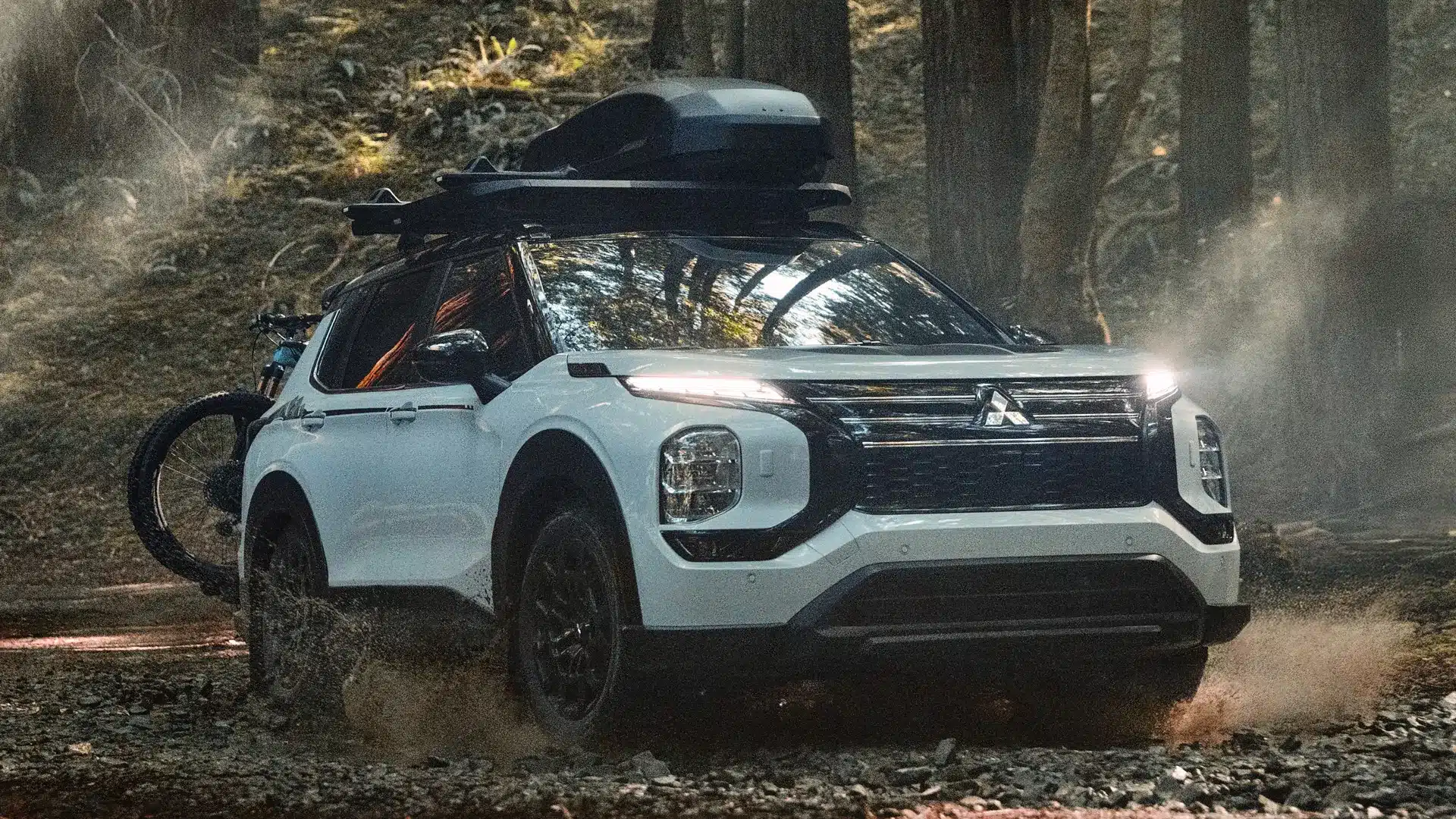
According to the company’s press release, the new off-road-focused Outlander expands on the brand’s legacy in all-terrain and off-highway travel. This model will build on the recently revealed Trail Edition package by incorporating distinct off-road bodywork, specialized drive modes, performance upgrades, and unique interior elements. Central to the design is Mitsubishi’s renowned Super-All Wheel Control (S-AWC) system, which has been meticulously refined through the company’s impressive accomplishments in the Dakar Rally and World Rally Championship.
Anticipating the final production model, one can expect several enhancements such as fender flares, distinctive wheels equipped with all-terrain tires, and possibly a slight lift for improved ground clearance. While the initial teaser image presents the standard Outlander next to a covered model, details like roof racks or major height changes remain uncertain.
The previous Outlander Trail Edition, priced around $40,000, featured stylish wheels and some aesthetic enhancements. Although it shares a platform with the Nissan Rogue and is powered by a less potent engine, reviews have been mostly favorable. It’s worth noting that while the Outlander’s specifications may not be groundbreaking, its pricing (starting at $30,000) and features, such as a 10-year/100,000-mile powertrain warranty and a two-year limited maintenance program, make it a competitive option on the market.
The identity of this new off-road model is yet to be revealed; however, it doesn’t need to be a hardcore rock crawler to capture interest. A thoughtfully designed package that enhances its aesthetic while providing functional upgrades can make a significant difference, especially for drivers eager to tackle light off-roading conditions like fire roads, where good tires and around 8 inches of ground clearance can suffice.
This recent marketing strategy marks a departure from past initiatives, as Mitsubishi emphasizes its Dakar Rally heritage to resonate with a new generation of car enthusiasts. The company has a storied history of producing exceptional on- and off-road vehicles, dominating the rally circuit in the late 20th century, but it has seemed less visible in recent years. The discontinuation of the impactful Lancer Evo X a decade ago left a void for many automotive fans.
Given the surge in popularity surrounding off-road vehicles and the nostalgic appeal of Mitsubishi’s rally legacy, it seems the company recognizes an opportunity to re-engage potential customers. By infusing its upcoming SUV with both modern features and a nod to past triumphs, Mitsubishi aims to capture interest and possibly reclaim its position in the off-road segment.